

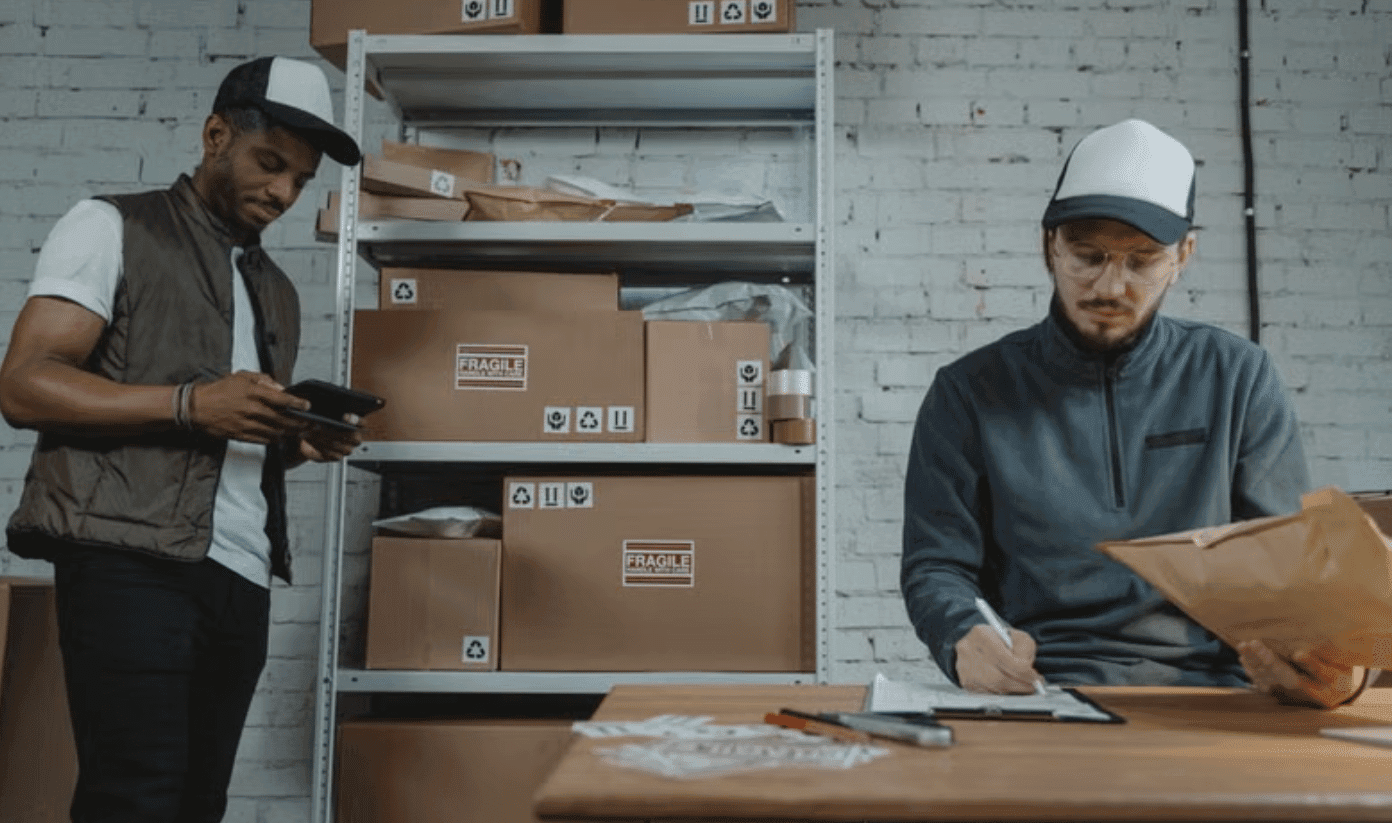
Imagine a skincare brand on Shopify landing a stockist at a national chemist chain six months later. Almost overnight, their warehouse is doing two very different jobs.
One order is a single jar going to someone’s home. The other could be four hundred units on a pallet, headed for a distribution centre with its own unique set of rules.
It’s a familiar path for Australian brands moving from direct-to-consumer into wholesale. And it’s often the moment a brand realises B2C and B2B fulfilment in Australia aren’t the same job at a bigger scale.
This guide walks through exactly where B2B and B2C fulfilment diverge, why the difference is an expensive one to learn on a live wholesale order, and what it takes to run both well.
What Is B2B Fulfilment?
B2B fulfilment is the process of shipping bulk orders to another business, usually a retailer, distributor or wholesaler, against a purchase order. Orders are large (cartons or full pallets rather than single items), shipped via freight rather than a courier, and often need to meet the receiving business’s own compliance requirements before a shipment is even accepted at the dock.
What is B2C Fulfilment?
B2C fulfilment is the version most people picture when they hear “ecommerce fulfilment”: picking and packing individual orders for a single customer, then sending each one out via a parcel carrier like Australia Post, StarTrack or Aramex. Order volume is high, order size is small, and the customer’s expectations around speed and presentation are set by whichever brand shipped to them last.
Plenty of Australian brands run B2B and B2C both at once
A warehouse might dispatch forty single-unit parcels to home addresses on a Tuesday morning, then load a pallet that same afternoon for a retailer’s regional distribution centre. Same stock, same warehouse, two entirely separate sets of rules for how it has to move.
B2B vs B2C Fulfilment at a Glance
Before getting into why each of these differences matters day to day, here’s the shape of it side by side. Everything after this table unpacks one row of it.
| Factor | B2B Fulfilment | B2C Fulfilment |
| Typical order size | Cartons to full pallets | Single item to a few items |
| Order frequency | Weekly, fortnightly, or per purchase order | Continuous, often multiple times a day |
| Units per order | Dozens to thousands | Usually 1–5 |
| Picking method | Carton or pallet picking | Piece picking |
| Packaging | Bulk cartons, shrink-wrap, pallet labelling | Branded satchels or boxes, unboxing extras |
| Shipping method | Freight and pallet networks | Parcel carriers |
| Lead time expectation | Days, set by the PO and dock booking | Same-day dispatch for orders received before the cut-off, otherwise next-day dispatch |
| Compliance requirements | GS1 barcodes, ASN, EDI, retailer specs | Minimal beyond standard labelling |
| Returns profile | Low volume, high value, slower to reconcile | High volume, fast, consumer-driven |
| Cost per unit | Lower, but compliance labour adds up | Higher per order, scales with every sale |
A retailer’s distribution centre and a home address ten suburbs over are handled by two separate playbooks, even when the stock sitting on the shelf is identical.
The Differences That Change Your Operation
Order Profile
A B2C order is one customer buying one or two things for themselves, whenever the mood strikes. A B2B order is a single purchase order covering hundreds, sometimes thousands, of units, timed to a retailer’s replenishment cycle rather than anyone’s shopping mood.
That difference shapes how the whole warehouse runs. A warehouse built for B2C handles hundreds of small, fast-moving orders every day. One built for B2B deals with fewer, much larger movements that need to land on a specific date. Running both well means the operation has to flex between the two without either one slowing the other down.
Picking
B2C fulfilment runs on piece picking: one person picking single items into a single customer’s order, over and over, all day.
B2B fulfilment looks more like carton or pallet picking: pulling whole cartons of stock, building a pallet to the retailer’s exact spec, then wrapping and labelling it as one unit. It’s a slower, more deliberate process per order, but each pick moves a lot more stock at once.
Get pick and pack wrong on a B2B order and the fallout isn’t one unhappy customer. It’s a pallet that gets knocked back at the dock.
Packaging
A B2C order is often part of the product experience itself. Tissue paper, a branded mailer, a thank-you card tucked inside, all of it shapes how a customer feels about the brand before they’ve even opened the box.
A B2B order doesn’t need any of that. What it needs is a correctly wrapped, correctly labelled carton or pallet that meets the receiving retailer’s exact packaging spec, right down to where the label sits.
Shipping
B2C orders travel through parcel networks: Australia Post, StarTrack, Aramex, carriers built to handle huge volumes of small, individually addressed items.
B2B orders move through freight and pallet networks instead, on linehaul trucks, booked into a specific delivery window at a retailer’s distribution centre. Miss a booked dock slot by even an hour and the load can be turned away and rebooked for another day, which is a different kind of problem to a parcel running a day late.
Returns
B2C returns come back constantly, in small volumes, driven by a customer changing their mind or ordering the wrong size. The process needs to be fast, since unsold stock sitting in a returns pile is stock that isn’t earning its keep.
B2B returns look almost the opposite. Low in volume, but each one can represent real value, whether that’s a pallet a retailer sends back over a quality issue or a wholesale order adjusted after the fact. Reconciling a B2B return usually takes longer too, because it’s tied to an account relationship and a purchase order, not a single transaction.
Cost Structure
B2B fulfilment tends to bring the cost per unit down, since one pick, one pack and one freight movement can cover hundreds of units at once. What it adds instead is compliance labour: labelling, ASNs, and the admin that keeps a wholesale account running smoothly.
B2C fulfilment works the other way. Cost per unit is higher, because every single order needs its own pick, pack and postage label, and that cost climbs in a straight line with every order that comes in.

Australian Retailer Compliance: Where B2B Orders Go Wrong
This is the part of B2B fulfilment that catches brands out, mostly because it doesn’t show up anywhere in a B2C operation.
Major Australian retailers won’t accept a pallet that doesn’t meet their exact compliance requirements, and those requirements go well past “get the order right.”
GS1 Barcodes and SSCC Pallet Labels
Every pallet needs a GS1 logistics label carrying an SSCC, a Serial Shipping Container Code: an 18-digit number that uniquely identifies that specific pallet, built from your GS1 Company Prefix and printed as a scannable barcode on at least two sides.
Retailers scan that code on arrival to match the physical pallet against your electronic paperwork, and it needs to line up exactly.
Mismatched SSCC data is one of the most common reasons a pallet gets flagged at receiving.
Advance Shipping Notices and EDI
Before the pallet even arrives, most retailers expect an Advance Shipping Notice, an electronic message, usually sent via EDI, telling their system exactly what’s coming: how many units, which cartons, which SSCC numbers to expect. If that ASN doesn’t match what physically turns up, the shipment can get held up while someone works out why.
Dock Booking and Carton Labelling
On top of the pallet label, individual cartons usually need their own GS1-128 barcodes, and the pallet itself has to be booked into a specific delivery window at the retailer’s distribution centre. Turn up outside that window, or with paperwork that doesn’t match, and the load can be turned away rather than simply queued.
Get any one of these pieces wrong- mismatched SSCC data, a missing ASN, a barcode that won’t scan, and a retailer generally doesn’t just query the one carton that’s off. The whole delivery can bounce back, which is a very different outcome to a single B2C parcel going astray.
Running B2B and B2C From One Inventory Pool
Split stock across two separate warehouses, or two separate systems inside the same one, and B2B and B2C start competing with each other in ways that are hard to spot until they’ve already caused a headache.
Say a DTC channel gets a sudden spike, a product goes viral, a campaign lands better than expected, but the stock that could cover it is sitting in a separate wholesale allocation the website can’t see.
Either the online store oversells, or a wholesale order can’t be filled because nobody moved stock across in time. Either way, someone’s let down, and the usual fix is a manual scramble rather than a system doing its job automatically.
Running B2B and B2C fulfilment from one real-time inventory pool solves this at the source:
- One stock count across every channel, so the website, marketplace listings and wholesale allocation are all reading from the same number
- The flexibility to shift stock toward whichever channel needs it that week, rather than it sitting stranded in the wrong bucket
- No duplicate storage fees for holding the same SKU twice because two systems can’t talk to each other
This only works if ecommerce platform integrations can connect every sales channel to the same warehouse system in real time, rather than syncing on a delay. A stock count that was accurate as of yesterday afternoon isn’t much better than no stock count at all when a wholesale order and a DTC spike land in the same week.
Good inventory management treats B2B and B2C as two channels drawing from one pool. They aren’t separate businesses that happen to share a warehouse.
What Each Model Costs in Australia
B2B and B2C fulfilment are priced differently because the work itself is different. It isn’t a matter of one provider charging less than another.
B2B costs are usually built from:
- Pallet or carton storage
- Carton picking and palletising labour
- Freight to the retailer’s distribution centre
- Compliance labelling, including GS1 barcodes, SSCC generation and ASN admin
B2C costs are usually built from:
- Shelf or bin storage
- Piece picking labour
- Packaging materials, especially where there’s a branded unboxing element
- Parcel postage per order
- Returns management for the volume of items coming back
Per unit, B2B fulfilment tends to come out cheaper. Moving five hundred units on one pallet, through one pick and one freight booking, spreads the cost a long way. What eats into that saving is compliance labour: every hour spent on SSCC labels and ASN admin is an hour a pure B2C operation never has to spend.
B2C fulfilment is usually the cheaper one to get started with. There’s no compliance overhead and no minimum order size. The trade-off is that cost scales in a straight line with volume: a thousand extra orders means a thousand extra picks, packs and postage labels, every single time.
Neither model is “the cheap one.” They’re just built differently, and the real number for your brand depends on order volume, SKU count and channel mix, which is exactly what a proper fulfilment quote should be based on, rather than a flat rate card.
How to Choose a 3PL That Handles Both
Not every 3PL that’s good at B2C is automatically set up for B2B, and the reverse is just as true. Before signing with a provider to run both, it’s worth asking a few direct questions on the discovery call:
Which retailers do you already ship into?
A provider with a track record against major retailer compliance requirements has already solved problems your brand hasn’t hit yet.
Do you run freight alongside parcel?
If pallet freight is an afterthought bolted onto a parcel-first operation, B2B orders will always be the ones that get deprioritised.
Is it one inventory pool across channels, or two?
This single question decides whether anyone ever has to manually shuffle stock between a wholesale allocation and the online store.
What visibility do I get?
You should be able to see stock levels, order status and compliance documentation yourself, without needing to ask and wait.
Do you integrate with my platform, and with EDI?
Both matter if there’s a Shopify store running alongside a wholesale account that expects electronic ASNs.
What certifications do you hold?
Ask about anything with its own compliance chain, whether that’s food and beverage or cosmetics.
A provider with excellent 3PL warehousing across both channels, with capacity available for 3PL in Sydney and 3PL in Melbourne, is in a very different position to one that’s built for single-item parcels and treats wholesale as an afterthought.
Looking for B2B and B2C Under One Roof?
B2B and B2C fulfilment are genuinely different jobs. The order profiles, picking methods and shipping networks are all different, and once a retailer’s compliance requirements come into play, so is the rulebook.
The brands that handle both well choose a 3PL that’s built for each, running from one real-time inventory pool rather than two systems bolted together after the fact.
That’s exactly what we do at NP Fulfilment. You get one warehouse, one live stock count and a team that already knows what a retailer’s dock booking window and an SSCC label are supposed to look like.
Whether you’re adding your first wholesale account or juggling DTC and B2B channels that already clash, request a fulfilment quote, and we’ll show you what your operation needs to run both well.
Frequently Asked Questions
Can one 3PL handle both B2B and B2C fulfilment?
Yes, provided they run pallet freight and parcel shipping side by side, and hold stock in a single inventory pool rather than splitting it across separate systems for each channel.
What is an ASN, and do I need one?
An Advance Shipping Notice is an electronic message, usually sent via EDI, that tells a retailer exactly what’s on its way before a shipment arrives. Most major Australian retailers require one for wholesale orders.
Is B2B fulfilment cheaper than B2C?
Usually cheaper per unit, since one pick and one freight movement covers a much larger quantity of stock. Compliance labour narrows that gap, so the real comparison depends on your specific order profile.
What is EDI, and when do I need it?
Electronic Data Interchange is the system retailers use to exchange purchase orders, invoices and ASNs electronically. You’ll need it as soon as a retailer’s compliance requirements call for it, which is standard practice for most major Australian chains.
Do I need separate stock for wholesale and online orders?
No. A single, real-time inventory pool lets both channels draw from the same stock, which avoids overselling and stops stock sitting stranded in the wrong allocation.
How long does it take to add a wholesale channel to an existing fulfilment setup?
That comes down to the retailer’s onboarding requirements, but plan for several weeks to sort compliant labelling, ASN integration and dock booking before the first pallet ships.